Demystifying Automated Testing: What It Is, Why It Matters, and How to Do It Right

In this page
Introduction
In today’s fast-paced software development world, the pressure to release reliable, high-quality applications at breakneck speed is higher than ever. One of the key practices that makes this possible is automated testing. But what exactly does it mean to automate your tests, and why is it considered such a cornerstone of modern software engineering?
This blog explores the fundamentals of automated testing, its benefits, popular development methodologies like Test Driven Development (TDD) and Behavior Driven Development (BDD), the role of the test pyramid, and some of the common challenges teams face when putting it into practice.
What Is Automated Testing?
Automated testing is the practice of using software tools to run tests on code with minimal human intervention.
Instead of manually clicking through user interfaces or running scripts yourself, automated tests are executed by machines to validate that your software behaves as expected.
These tests can run every time code changes are made, providing instant feedback and helping developers catch bugs before they reach production.
Why Is Automated Testing So Valuable?
Speed and Efficiency
Automated tests run much faster than manual tests, especially when testing large applications. They can be run frequently (e.g., on every code commit) and in parallel, making continuous integration and delivery (CI/CD) feasible.Reliability and Consistency
Humans are fallible—manual testing can miss steps or yield inconsistent results. Automated tests execute the same way every time, ensuring repeatable, trustworthy outcomes.Cost Savings in the Long Run
Although there’s an upfront cost to writing automated tests, they pay off by reducing the time spent on bug fixes, manual testing, and post-release firefighting.Faster Feedback Loops
Developers get immediate feedback on whether their code works, enabling quicker iterations and fewer bugs slipping through.
Automated testing does more than just verify that new functionality meets the specified requirements. It also serves as a critical safety net for the future, catching unexpected conflicts when new features inadvertently interfere with existing behavior that may have been overlooked.
Imagine you’re managing a large suite of systems and need to modify some code. Wouldn’t it be reassuring to quickly run a comprehensive suite of automated tests that confidently confirm you haven’t introduced any new bugs? Even better, if any tests fail, they provide clear, actionable feedback — with detailed assertion messages — pinpointing the exact issue caused by your changes. This way, problems are caught early in the development cycle, rather than surfacing weeks later during User Acceptance Testing or, worse, in production.
The following highlights of the increasing cost to fix a problem at the various stage gates really brings it home

High-Level On Some Testing Methodologies
Test-Driven Development (TDD)
TDD flips the conventional development process on its head. Instead of writing code first, you start by writing a test that describes a desired behavior or functionality. The process typically follows the Red-Green-Refactor cycle:
- Red – Write a failing test.
- Green – Write the minimum code required to make the test pass.
- Refactor – Clean up the code while keeping the test passing.
TDD helps ensure that code is testable, modular, and aligned with requirements from the outset.
We will explore TDD in detail in an upcoming post.
Behavior-Driven Development (BDD)
BDD builds on TDD but focuses more on collaboration and communication. It encourages developers, testers, and business stakeholders to define application behavior using natural language syntax (e.g., Gherkin). A common format is:
Feature: Returns and exchanges go to inventory.

  As a store owner,
  I want to add items back to inventory when they are returned or exchanged,
  so that I can track inventory.

  Scenario: Items returned for refund should be added to inventory.
  Given that a customer previously bought a black sweater from me
  And I have three black sweaters in inventory,
  When they return the black sweater for a refund,
  Then I should have four black sweaters in inventory.
BDD makes tests easier to understand and aligns technical and non-technical team members around the expected behavior of the system.
A deep dive into BDD will follow shortly in another post.
The Test Pyramid: A Guide to Layered Testing
One of the most important concepts in test automation is the test pyramid, introduced by Mike Cohn. It’s a visual metaphor for how different types of tests should be distributed in your testing strategy:
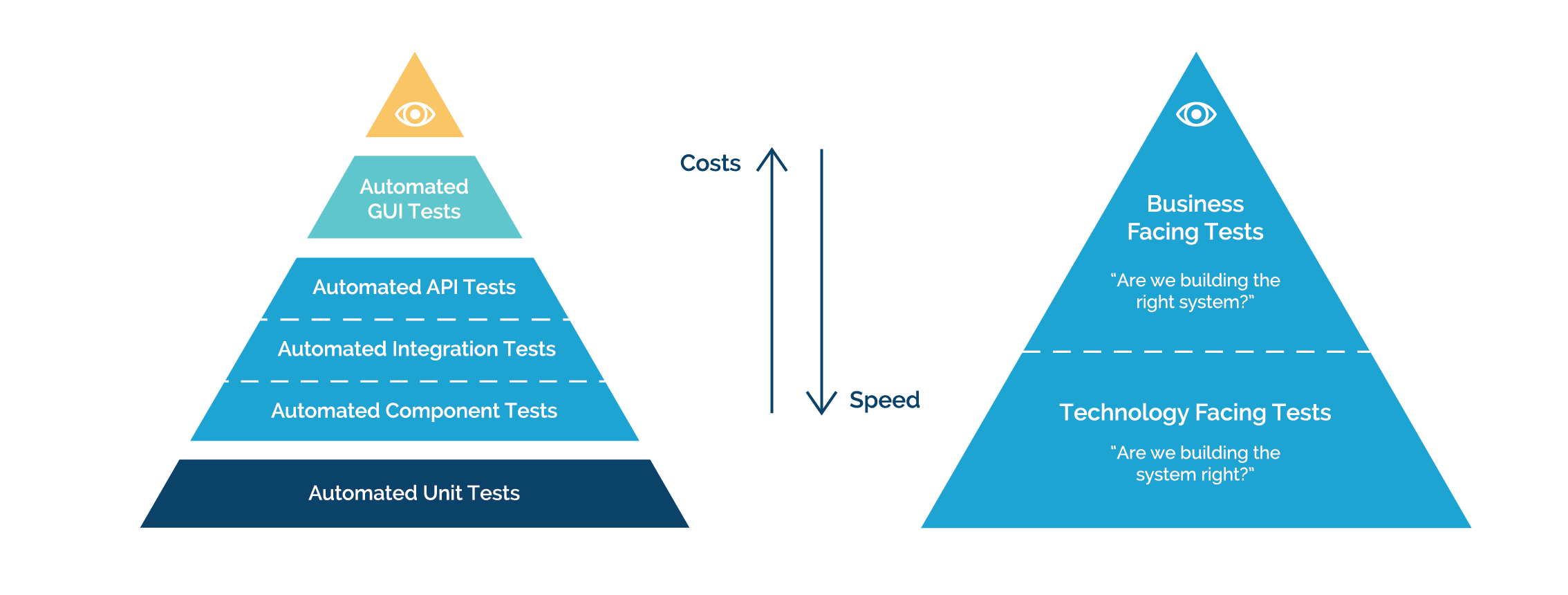
- UI / End-to-End Tests: Simulate real user interactions. They provide high confidence but are often slow and brittle.
- Service / Integration Tests: Test interactions between components or with external systems like databases or APIs.
- Unit Tests: Test individual pieces of code (e.g., functions, methods). They are fast and provide quick feedback.
The pyramid advocates for having more low-level tests and fewer high-level tests, optimizing for speed and maintainability.
Alternatives to the test pyramid
- Testing Trophy: Introduced by Kent Dodds, this model emphasizes static and integration tests more than unit tests, adapting to modern testing needs.
- Reverse Pyramid: Flipping the pyramid, this model suggests focusing more on E2E tests to simulate user experiences better.
- Test Diamond: An evolution of the traditional test pyramid, advocating for more integration and service tests compared to the test pyramid, while still maintaining a strong base of unit tests and a smaller number of end-to-end tests at the top.
- Test Honeycomb: A modern testing framework that promotes extensive and diverse testing methodologies, emphasizing the importance of exploratory testing, performance testing, and security testing in addition to the traditional layers of unit, integration, and end-to-end tests.
Common Challenges in Automated Testing
Despite its benefits, automated testing isn’t without hurdles:
High Initial Investment
Writing and maintaining automated tests takes time, especially for legacy systems that weren’t built with testing in mind.Flaky Tests
Tests that sometimes pass and sometimes fail (especially UI tests) erode trust and can lead to ignored failures.Overtesting or Redundant Testing
Teams sometimes write too many similar tests across layers, leading to bloated test suites and slower pipelines.Maintenance Overhead
As applications evolve, test suites must be updated. Poorly written tests can become a burden rather than an asset.Lack of Test Coverage Strategy
Without a solid plan (like the test pyramid), teams might write too many end-to-end tests and not enough unit tests, leading to slow feedback and fragile builds.
Final Thoughts
Automated testing isn’t just a nice-to-have—it’s a critical component of modern software development. When implemented thoughtfully, it enables faster delivery, greater confidence in code, and fewer late-night bug hunts.
Whether you’re just starting with unit tests, exploring TDD, or aligning stakeholders with BDD, remember: the goal is to create a safety net that empowers developers to move fast without breaking things.
Start small, iterate, and build your way to a robust, reliable testing culture.
Resources
- Phoenix Project A great read, and personally it was surprising how much I could relate to the project they were delivering. This is why I now push automated testing, CI, CD etc so much
- Google Testing Blog Insights and practices from Google’s testing teams.
- Martin Fowler — Test Automation A thoughtful overview by one of the leading software development thinkers.
- Test Automation University Free courses covering various testing tools, frameworks, and best practices.