Behavior Driven Development: A Practical Guide
In this page
Background
Behavior Driven Development (BDD) has gained significant traction in the software development world over the past decade. It’s more than just a testing approach—it’s a collaborative process that helps teams deliver software that truly meets user needs.
BDD originated from Test Driven Development (TDD) and was popularized by Dan North around 2006. While TDD focuses on writing tests before code to drive design and ensure functionality, BDD extends this concept by emphasizing communication and shared understanding among developers, testers, and business stakeholders.
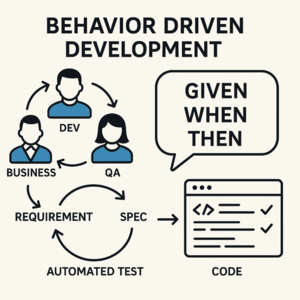
At its core, BDD encourages writing software behavior in a human-readable, domain-specific language using examples. These behaviors are typically documented in “Given-When-Then” format, making requirements more accessible and unambiguous:
Feature: Returns and exchanges go to inventory.

  As a store owner,
  I want to add items back to inventory when they are returned or exchanged,
  so that I can track inventory.

  Scenario: Items returned for refund should be added to inventory.
  Given that a customer previously bought a black sweater from me
  And I have three black sweaters in inventory,
  When they return the black sweater for a refund,
  Then I should have four black sweaters in inventory.
This format helps bridge gaps between technical teams and business users, ensuring everyone agrees on what the software should do.
Why BDD is Good: Key Benefits
Enhanced Collaboration
BDD fosters conversations between product owners, developers, and testers before coding begins. This collaboration ensures the product meets real business needs and reduces misunderstandings.Clearer Requirements
Writing behaviors as examples makes requirements concrete and testable, reducing ambiguity in specifications and minimizing rework.Living Documentation
BDD scenarios double as documentation that’s always up to date since they’re directly linked to automated tests. This living documentation helps new team members understand the system quickly.Better Test Coverage and Quality
Because BDD encourages thinking about edge cases and user flows early, the resulting automated tests tend to cover critical paths and real-world scenarios effectively, improving software quality.Supports Agile Practices
BDD fits naturally into Agile environments by supporting iterative development, continuous feedback, and close stakeholder engagement.
Common Challenges in BDD Adoption
Initial Learning Curve
Teams new to BDD often struggle with understanding the format, writing effective scenarios, and integrating tools into their workflow.Over-Specification
Writing too many granular scenarios or including unnecessary implementation details can make scenarios brittle and hard to maintain.Tooling and Integration
Choosing the right BDD frameworks and integrating them with CI/CD pipelines can be tricky, especially in legacy environments.Collaboration Discipline
BDD requires active participation from all stakeholders. Without consistent collaboration, scenarios may become outdated or irrelevant.Misunderstanding BDD Purpose
Sometimes BDD is mistaken for just a testing framework rather than a collaborative practice that influences the entire development process.
Productivity Concerns When First Adopting BDD
Introducing BDD can initially slow teams down due to:
- Time spent learning the syntax and tooling,
- Extra effort in writing scenarios before coding,
- More meetings to facilitate collaboration,
- Rewriting scenarios as the team improves their approach.
However, these short-term slowdowns usually pay off as teams develop a shared understanding and reduce bugs and rework. Over time, BDD can boost productivity by preventing defects early and ensuring the team builds the right product.
Tips to ease the transition:
- Start small by applying BDD to critical features first.
- Train teams on effective scenario writing and BDD principles.
- Use tools that integrate smoothly with your existing tech stack.
- Encourage regular collaboration sessions between developers, testers, and business stakeholders.
- Continuously review and refactor scenarios to keep them relevant.
Popular BDD Tools

- Cucumber Supports multiple languages (Ruby, Java, JavaScript, etc.), many features and well supported
- SpecFlow BDD framework for .NET, similar to Cucumber
- JBehave Another popular BDD framework for Java
- Serenity BDD Serenity actually extends and complements Cucumber rather than replacing it
- Pickles Living documentation tool that works well with SpecFlow
Final Thoughts
Behavior Driven Development is much more than writing tests before code—it’s about fostering shared understanding and collaboration. While it requires effort to adopt and maintain, the benefits in terms of clearer requirements, better quality, and improved communication can significantly outweigh the initial investment.
For teams committed to Agile, continuous improvement, and delivering business value, BDD offers a powerful approach to bridge the gap between business intent and software implementation.
Resources
- Cucumber Official Site — Popular BDD tool and framework with extensive documentation.
- Dan North’s Introduction to BDD — The seminal blog post that introduced BDD.
- SpecFlow (for .NET) — BDD framework for .NET environments.